How We Identify Exit-Ready UK Businesses
Of 3.7 million active UK companies, 1.8 million are real, independent trading SMEs. Our model runs them through two lenses (is it worth owning, is the owner likely to sell) to surface the 21,385 PURSUE-grade targets where a real business meets strong exit signals, before they list.
Of 3.7 million active UK companies filing accounts, 1.8 million are real, independent trading SMEs once you strip out dormant shells, non-trading micro-entities, financial holding companies, and subsidiaries of larger groups. Those are the businesses worth analysing for an acquisition.
From there, our model runs the same funnel you see on our homepage: of those real SMEs, 170,945 clear the business-quality gate. These are the companies genuinely worth owning. Layer the exit-timing lens on top and 39,318 show the signals of an owner likely to sell soon. The 21,385 we label PURSUE clear a higher bar still: a strong quality score rather than a merely passing one, and a profitable business with enough scale and financial strength to be worth acquiring today.
The succession crisis driving this analysis is vast. Just 7% of UK SMEs have succession planning fully integrated into their strategy, and 80% that try to sell fail to find a buyer.
The rest of this piece explains how each stage works, starting with the exit-timing signals, then the quality gate that turns "likely to sell" into "worth pursuing".
Find the companies that fit your buy box
Set the sector, region, EBITDA band and owner age you buy, and see which UK companies fit. The free trial includes 3 unlocks to reveal the companies behind the matches.
Build your buy box- Of 3.7 million active UK companies, 1.8 million are real, independent trading SMEs: the pool worth analysing.
- 170,945 clear the business-quality gate: the companies genuinely worth owning.
- 39,318 show strong exit-timing signals, meaning an owner our model reads as likely to sell soon.
- 21,385 are PURSUE-grade: a strong business AND strong exit signals. This is the actionable pipeline.
- 6 exit-timing signals feed the timing score: maturity, board changes, resignations, director age, tenure, no family successor.
- Companies with an average director age of 60+ average £335k net assets vs £207k for the general population.
- 80.9% of businesses with an average director age of 60+ show flat or declining capital investment.
- Top sectors for PURSUE targets: construction, B2B services, hospitality, manufacturing.
Why signals matter more than demographics
The traditional approach to finding acquisition targets relies on blunt filters. Director age over 65. Single director. Long tenure. These are useful starting points, but they produce enormous lists with no way to prioritise.
A company with a 68-year-old sole director who incorporated last year is fundamentally different from one where a 63-year-old has been running the business for 22 years and just had their first board resignation. The demographics are similar. The exit readiness is not.
Our model moves beyond demographics into behavioural signals: patterns in how a company is being run that correlate with a near-term change of ownership.
The 6 main exit timing signals
Our ML model evaluates companies across six dimensions, each weighted by its predictive power for exit timing:
1. Company maturity (10+ years)
A business needs to have been operating long enough to have established value, customer relationships, and operational patterns. Maturity alone doesn't signal exit, but it's a prerequisite for everything that follows.
2. Recent board changes
Board activity is one of the strongest signals in the model. When directors are appointed or resign, something is happening at the governance level. Only a minority of the companies we score have had board changes in the last three years, so when it fires, it matters.
3. Recent resignations specifically
Not all board changes are equal. Resignations carry a different signal to appointments. A resignation from a long-standing company often precedes a transition, whether planned or reactive. Recent resignations are rare, making this one of the strongest and most specific signals in the model: it's the "something is happening" indicator.
4. Ageing directors (60+)
Director age remains a fundamental input. Roughly a quarter of the companies we score have an average director age of 60 or older. When combined with other signals, age becomes the "why it's happening" indicator. On its own, it's a demographic fact. Combined with board changes and resignations, it tells a story.
5. Long tenure (15+ years)
Directors who have served 15 or more years have typically built the business around themselves. They hold the relationships, the institutional knowledge, and often the customer contracts. Long tenure combined with age creates acute key-person risk. It also creates an acute acquisition opportunity.
6. No family succession path
This is the most prevalent signal in the dataset: the overwhelming majority of the companies we score show no evidence of family succession infrastructure. No family members in officer records, no gradual handover pattern. The absence of an internal succession path is, by far, the most common condition among UK SMEs.
How signals accumulate
No single signal means a company is ready to sell. The model works on accumulation: the more signals that fire simultaneously, the higher the exit-timing score, and the more confident we are that an owner is approaching a decision.
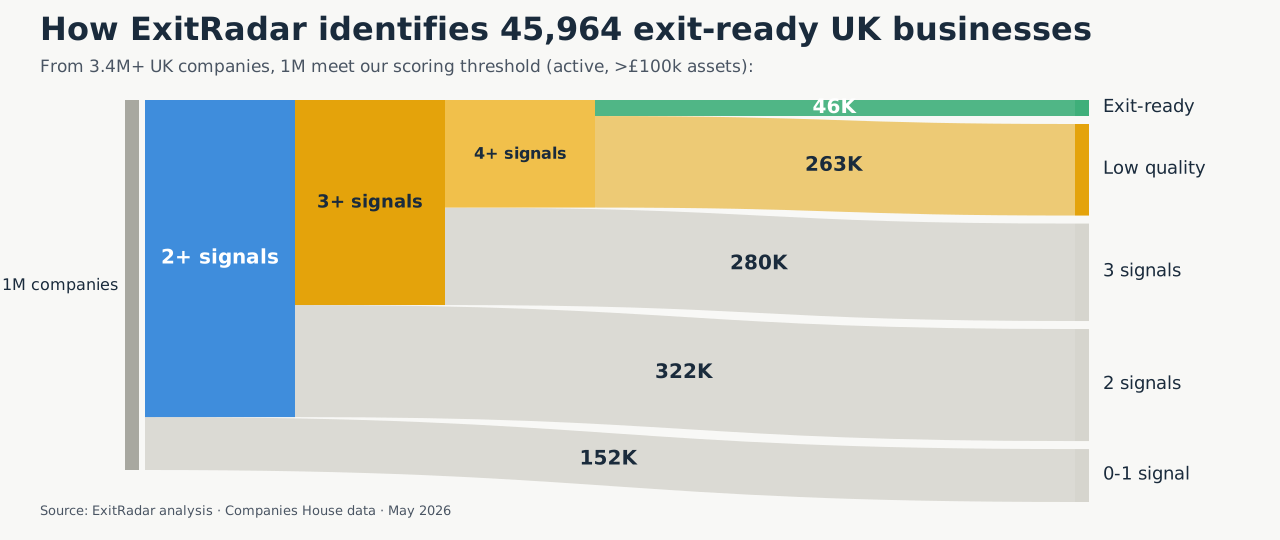
The pool narrows at each stage. A company where several indicators are active at once is not a speculative target, because the data is telling a consistent story about what comes next. That combined timing score is the "is it time?" lens; the next stage asks whether the business is worth owning at all.
Why signals alone aren't enough
A company can tick every exit timing box and still be a poor acquisition target. It might have declining revenues, thin margins, excessive debt, or a deteriorating competitive position. Exit timing tells you when a business might be available. Quality tells you whether it's worth pursuing.
Our model applies a quality gate that evaluates financial health, profitability track record, balance sheet strength, and asset scale. A business also has to be large enough to be worth the cost of a transaction. This is what separates the exit-ready from the exit-distressed, and the substantial from the too-small-to-bother.
Run the two lenses together and the funnel resolves. Of the 1.8 million real SMEs, 170,945 clear the business-quality gate, marking out the companies genuinely worth owning. Layer the exit-timing lens on top and 39,318 show the signals of an owner likely to sell soon. The 21,385 we label PURSUE clear a higher bar still: a strong quality score rather than a merely passing one, on a business sound and large enough to be worth acquiring. The overall acquisition score that ranks them combines exit timing (weighted at 45%) and business quality (weighted at 55%). For the headline numbers our model produces, see UK Business Exit Statistics 2026.
These PURSUE businesses aren't evenly distributed. Our postcode-level analysis reveals a wide gap in where they cluster across the UK.
The 21,385 aren't all the same. Some are £200,000 net asset businesses with one ageing director. Others are £5 million+ revenue operations where the founder has been at the helm for 25 years and the board just had its first resignation. The model scores them on a spectrum, not a binary.
What the 21,385 PURSUE targets look like
Companies with an average director age of 60+, the demographic core of the exit-ready cohort, show measurably stronger fundamentals than the general company population:
- Average net assets: £335k (vs £207k for the general population)
- Average current ratio: 3.5 (vs 2.8)
- Consecutive years of positive net assets: 74.8% (vs 64.6%)
These are conservatively managed, equity-rich businesses. They are 10 percentage points more likely than the general population to show consecutive years of positive net assets.
They are not distressed. They are not desperate. They are well-run businesses where the owner will, eventually, need an exit, and where the data suggests that "eventually" is closer than most people think.
The capex signal
One additional pattern is worth highlighting. Among businesses with an average director age of 60 or older, 80.9% show flat or declining fixed assets year-on-year. In the general population, that figure is 75.6%.
The 5-percentage-point gap is significant. It tells us that succession-age owners are running their businesses for cash yield rather than reinvesting for growth. They're extracting value rather than building it.
For acquirers, this is both a warning and an opportunity. The warning: deferred capital expenditure may mean ageing equipment, deferred maintenance, or underinvestment in technology. The opportunity: these businesses have latent upside that new ownership and fresh capital could unlock. The growth hasn't gone away. It has been deferred.
Why most of these businesses are invisible
Of the 21,385 PURSUE businesses our model identifies, the vast majority are not listed with a broker. They are not on any marketplace. They have no active sale process.
This is not because they don't want to sell. It's because they haven't started thinking about it, or they've thought about it and been paralysed by the complexity, the emotional weight, or the sheer lack of time.
The most recent Azets Barometer (2026 Q1) puts the share of UK SMEs with succession planning fully integrated into their strategy at just 7%, a pattern echoed by McKinsey's Great Ownership Transfer study, which documents the same crisis unfolding across the US, and by our UK analysis of the Great Ownership Transfer. Over 90% of small businesses that go to market fail to complete a sale. The broker model works for businesses that are ready to sell. But for the vast majority, where succession is a latent need rather than an active decision, traditional channels reach them too late or not at all.
This is the hidden market. And it's where the best acquisition opportunities sit: well-run businesses where the owner would be receptive to the right approach at the right time, but where no one has made the introduction. For regional distribution of high-scoring companies, see Where Are the UK's Exit-Ready Businesses?
What this means for acquirers
If you're a search fund operator, PE analyst, or strategic buyer, the 21,385 PURSUE businesses in our model represent a fundamentally different pipeline from what you'll find through broker listings and databases.
These are businesses where:
- Multiple succession signals are firing simultaneously
- Financial fundamentals are strong
- Competition from other buyers is minimal or nonexistent
- The owner is likely approaching a decision point, even if they haven't articulated it yet
The traditional approach to deal sourcing (monitoring broker listings, searching databases, attending networking events, cold-calling from Companies House) puts you in competition with every other buyer using the same channels. The multiples reflect it.
The alternative is to go upstream: identify businesses where no plan exists yet, approach them before they've spoken to a broker, and position yourself as the solution to a problem the owner is only beginning to acknowledge.
That's what signal-driven sourcing enables. Not cold-calling random companies. Intelligent matching based on objective, data-driven succession readiness.
The model in practice
ExitRadar's reports go beyond the score. For each company, we provide:
- Exit timing score: weighted across the 6 signals above, reflecting how many indicators are firing and how strongly
- Business quality score: financial health, asset base, profitability, and leverage assessment
- Overall acquisition score: the combined metric that ranks companies against each other
- Signal detail: which specific signals are active, with context on what they mean for this particular company
- Analyst note: approach recommendations, including suggested contact method, timing, and framing based on the owner's likely psychology
- Risk flags: customer concentration, key-person dependency, deferred capex, and other diligence considerations
The goal is not to replace due diligence. It's to tell you which doors are worth knocking on, and how to knock. See a sample ExitRadar report to understand what a full company analysis looks like.
This article is based on ExitRadar's analysis of 3.7 million UK companies with filed accounts, drawing on millions of officer and financial records from Companies House. All statistics are derived from ExitRadar's scoring model and refresh weekly.
ExitRadar is a UK-focused succession intelligence platform that identifies SMEs showing exit signals. Reports are available on a pay-per-unlock basis, with no subscription required. Browse exit-ready businesses by sector to see where the opportunities are concentrated.