UK Business Exit Hotspots: Where Exit-Ready Companies Cluster Across 12 UK Regions
20,138 UK companies are PURSUE-grade — where a real business meets strong exit signals. London and the South East together hold 30% — the top five regions account for 60.6% of the total. A regional map of where the acquisition pipeline concentrates.
- 20,138 UK companies are PURSUE-grade — a strong business meeting strong exit signals — spread across 12 UK regions
- London holds 3,196 of them (15.9% of the national total). With the South East's 2,848, the two regions together account for 30% (6,044 companies)
- The top five regions (London, South East, North West, East of England, South West) account for 60.6% of the total — concentration is sharper than it looks
- The three smallest regions (Wales, Northern Ireland, the North East) hold 1,939 PURSUE companies combined — far less competition per deal
- This map uses the same PURSUE definition as the homepage funnel, so it reconciles directly with our headline numbers, and refreshes weekly
Britain has 5.7 million private sector businesses. Over a third sit in London and the South East. Construction is the single largest sector, accounting for 15.8% of the entire business population, followed by professional services and wholesale trade.
Those are the numbers everyone cites. They come from the Department for Business and Trade's Business Population Estimates, published every autumn, and they describe where UK businesses are.
They don't describe where UK businesses are exitable.
That distinction matters. A business can exist for decades — filing accounts, employing staff, paying VAT — without ever being a realistic acquisition target. For a business to be exit-ready, something else needs to be true: an aging owner with no successor, strong enough financials to attract a buyer, and a structural profile that suggests the exit conversation would be welcome rather than premature.
We scored 3.7 million active UK companies on exactly those criteria. This article maps the results by region — showing where the succession pipeline concentrates, where it thins out, and what the geographic distribution implies for buyers.
The national baseline
Before going regional, the national picture sets the frame.
Across the 3,556,463 active UK companies whose director ages we hold, 23.9% have an average director age of 60 or older — 848,914 businesses led by people approaching or past traditional retirement age. That figure sounds manageable until you combine it with the structural vulnerability: 60.3% of UK companies have a single director. No co-directors, no named successors, no family members on the board. When that sole director retires, falls ill, or simply disengages, there is nobody else with legal authority over the business.
The overlap between those two facts — aging directors and single-director structures — is where succession risk concentrates. We have identified 173,612 companies with a sole director over 60, assets above £50,000, and no succession infrastructure. They hold £198.2 billion in aggregate assets. These are not marginal businesses. They are established, asset-backed companies with a single point of failure.
This is not a theoretical risk. In 2024, 296,880 UK companies shut down. Insolvency remained near 30-year highs into 2025, with one in 190 companies on the Companies House register entering a formal insolvency procedure. The Insolvency Service data consistently shows construction, retail, and hospitality bearing the heaviest losses — the same sectors where our data shows the highest concentration of aging sole directors.
McKinsey's Great Ownership Transfer report, published in February 2026, found that 92% of US small-business exits end in closure rather than transfer. The UK faces a proportionally identical pattern, as our UK analysis of the Great Ownership Transfer shows: the businesses don't fail because they're unprofitable. They disappear because no infrastructure exists to match them with buyers.
Our scoring model narrows the universe to where that match should be happening but isn't: the 20,138 PURSUE-grade companies where a real business meets strong exit signals. Here's where they sit geographically.
The regional league table
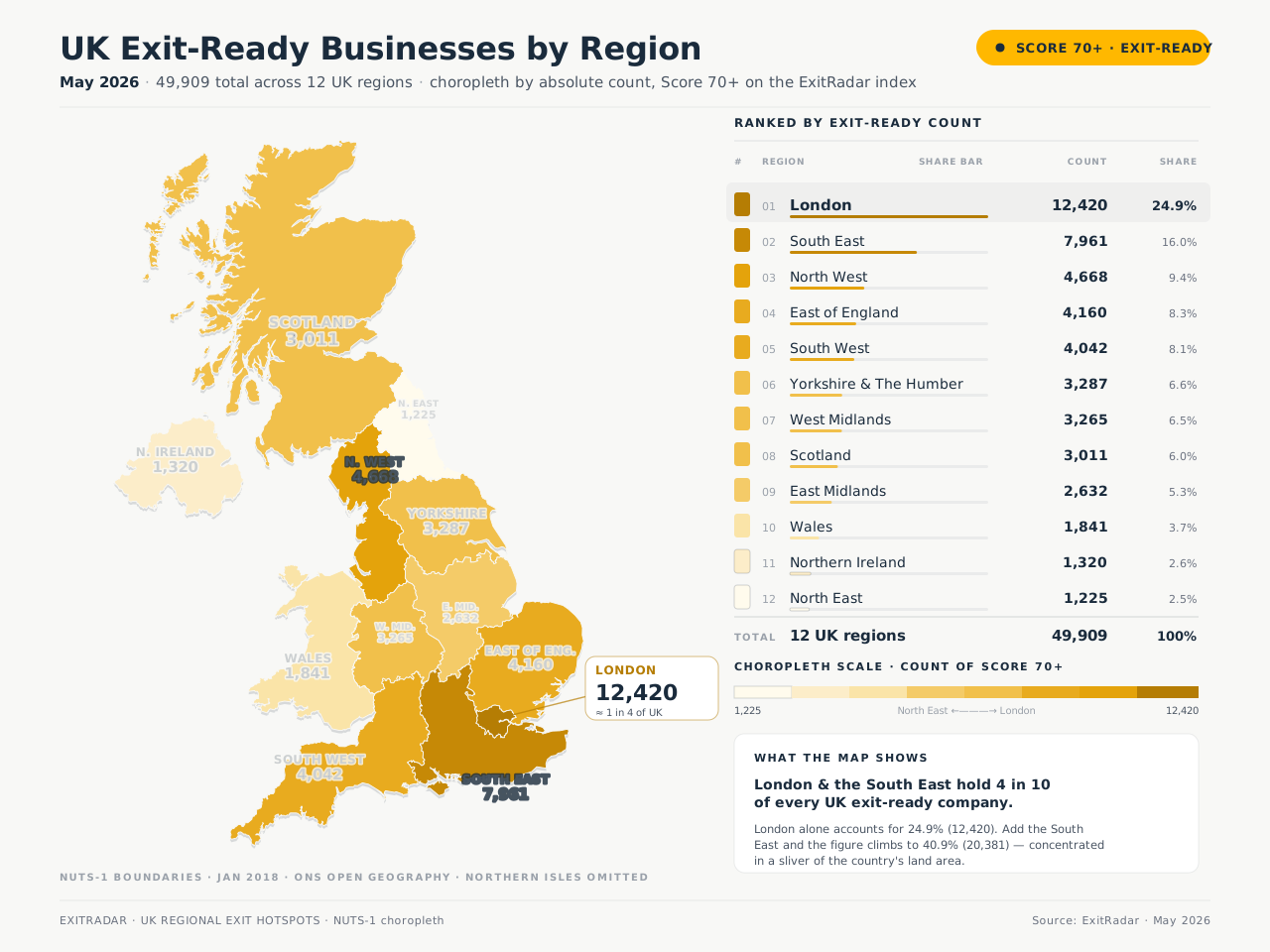
The map covers 12 UK regions — the 11 mainland NUTS1 regions plus Northern Ireland. (A handful of PURSUE companies have no region on record, so the regional rows sum to just under the 20,138 national total.)
| # | Region | PURSUE targets | Share of national total |
|---|---|---|---|
| 1 | London | 3,196 | 15.9% |
| 2 | South East | 2,848 | 14.1% |
| 3 | North West | 2,203 | 10.9% |
| 4 | East of England | 2,150 | 10.7% |
| 5 | South West | 1,813 | 9% |
| 6 | West Midlands | 1,760 | 8.7% |
| 7 | Yorkshire & The Humber | 1,509 | 7.5% |
| 8 | East Midlands | 1,439 | 7.1% |
| 9 | Scotland | 1,276 | 6.3% |
| 10 | Wales | 782 | 3.9% |
| 11 | North East | 594 | 3% |
| 12 | Northern Ireland | 563 | 2.8% |
| — | Total | 20,133 | 100% |
The most striking pattern in this data is concentration. The top five regions account for 60.6% of the total. The top two — London and the South East — account for 30% between them. The bottom three regions combined (Wales, Northern Ireland, the North East) hold 1,939 companies — roughly half London's.
The London + South East concentration
London alone holds 3,196 PURSUE-grade businesses — 15.9% of the entire UK total. Add the South East's 2,848 and the two adjacent regions together represent 6,044 companies, 30% of the national pipeline.
For acquirers, this matters. A London-centred search captures the largest single pool of opportunity in the country. The volume cuts both ways: it's also the most heavily worked geography in UK M&A. Every search fund operator, every regional broker, every PE business-development team has a London desk. Deal flow is dense, but so is the competition for each viable target.
The concentration is partly real and partly an artefact of where companies register. London's count is inflated by businesses whose operating reality sits outside the M25 but whose registered office is in zone 1 for prestige or accountancy convenience. Even net of that effect, though, London is the country's deepest single-region pipeline by a wide margin.
The South East — Essex, Kent, Surrey, Hampshire, Berkshire, Sussex — holds the second-deepest pipeline by count and the natural overflow geography for buyers priced out of the central London search. It contains the long-tenured, asset-backed owner-operators who built businesses serving London's economy from the surrounding counties: the commuter-belt effect, in M&A form.
The mid-tier: large enough to matter, less worked than London
The 3rd-through-9th regions — North West, East of England, South West, West Midlands, Yorkshire & The Humber, East Midlands, Scotland — together hold 12,150 PURSUE companies, 60.3% of the national total.
None of these regions individually rivals London, but they are the practical hunting ground for searchers who don't want to compete head-on with the London-centric default.
Each is large enough to support multiple parallel mandate threads, small enough that a focused operator can become a known name in the local market. The North West (2,203) is the third-deepest regional pipeline after London and the South East and sustains a meaningful base of independent buyers, brokers, and advisers. Yorkshire & The Humber (1,509) and the West Midlands (1,760) are close in scale; the East Midlands (1,439) sits just behind. Scotland's 1,276 are concentrated in the Central Belt and operate with their own legal and advisory ecosystem that London-based buyers often underweight.
The long tail: Wales, Northern Ireland, and the North East
The bottom three regions — Wales (782), Northern Ireland (563), and the North East (594) — hold 1,939 PURSUE companies between them.
The data point that matters most for these regions is competitive intensity, not size. London-based buyers default to the South East before any other geography. Northern brokers cluster in Manchester and Leeds. Few search fund operators headquartered south of the Midlands have built sustained sourcing infrastructure in Wales, NI, or the North East.
A searcher operating in these markets encounters far fewer competing acquirers per viable target. The geography rewards the operator who is willing to look outside the obvious South East corridor — and, increasingly, to look outside Great Britain entirely.
Northern Ireland
Northern Ireland holds 563 PURSUE-grade businesses across the province — the smallest of the 12 UK regions, and one where Companies House records can lag operational reality, so read the count as a floor. It shares the same broad dynamics as the other long-tail regions: smaller absolute counts, less competitive deal sourcing, established owner-operator businesses.
For UK-mainland-based searchers, NI carries some specific considerations: a separate corporate registry overlay in some industries, different VAT treatment under the Windsor Framework, and a smaller pool of regional brokers. For US-based searchers familiar with cross-border deal mechanics, NI is the most natural English-speaking jurisdiction to add after Great Britain itself.
The demographic pipeline: what's coming next
The current exit-ready pipeline is drawn primarily from directors aged 60 and above. But the wave behind them is larger.
Across our database, 1,027,755 companies have directors in the 50-60 age bracket — more than a million businesses whose directors will age into the 60+ cohort over the next decade. The 40-50 bracket — the wave after that — contains 1,012,908 companies. The pipeline of future succession pressure doesn't taper off — it holds.
Tax policy compounds the urgency. Business Asset Disposal Relief carries an 18% rate from April 2026, up from 10% just two years ago. For an owner of a business worth £1 million, that's an additional £80,000 in tax by waiting. The window for tax-efficient exits is narrowing, which should accelerate the flow of businesses into active exit postures over the next two to three years.
Meanwhile, business closures remain elevated. Many of those closures will be viable businesses that never found a buyer — the same pattern McKinsey documented in the US, where the businesses didn't fail but the market for transferring them simply didn't function.
What this means for buyers
The data points to three clear strategic implications.
London and the South East are the volume markets, but they're also the most competitive. 30% of the country's PURSUE pipeline sits in those two regions, and every serious UK buyer knows it. A differentiated approach — sector specialisation, direct-to-owner outreach, or targeting specific sub-segments — is necessary to stand out from the brokers and searchers working the same geography.
The mid-tier regions (3rd through 9th) collectively hold more than half the national pipeline. They are large enough to sustain a focused operator and less worked than the South East default. The North West, in particular, is the third-deepest regional pipeline in the country and routinely underweighted by London-centric search.
The smaller regions (Wales, Northern Ireland, North East) offer the best ratio of opportunity to competition. Their absolute deal counts are lower, but a search fund operator or broker willing to base themselves in or focus their sourcing on these markets faces measurably less competition per viable target. For a broker sourcing mandates or a search fund defining its geography, the bottom three regions deserve more attention than they currently receive.
The businesses exist. The data to find them exists. The question is whether buyers will keep competing for the same London and South East targets or expand their attention into the rest of the country.
This analysis is based on ExitRadar's database of 3.7 million active UK companies, derived from public Companies House filings under the Open Government Licence v3.0. Director ages are based on 10-year age brackets. Financial figures are drawn from the most recently filed accounts. Enterprise value — which includes earnings multiples and goodwill — would be significantly higher than the balance sheet figures cited here.
National business population statistics are sourced from the Department for Business and Trade's Business Population Estimates 2025. Business closure and insolvency data from the ONS Business Demography series and the Insolvency Service. The McKinsey Institute for Economic Mobility report "The Great Ownership Transfer" was published in February 2026.
About ExitRadar: ExitRadar analyses public UK company data to identify businesses showing succession and exit signals. Our reports provide pre-approach intelligence for search fund operators, business brokers, and prospective acquirers — helping qualified buyers find businesses ready to transition before they disappear from the market. Explore a free sample report or browse by sector.